

by Jack Cunningham, Lean & Process Excellence Lead
When a Quality/Regulatory team is struggling with growing workloads, backlogs and resource constraints, the obvious response is to look for more capacity. That might mean more people, new systems or, increasingly, AI. Before investing in any of these, I think there’s a more fundamental question to ask:
Is the problem a lack of resources, or the way the work has been designed?
The distinction matters. If the underlying process is inefficient, adding technology may just let us run that inefficient process faster. The bigger opportunity is to step back, understand how the work really gets done, redesign it, and only then decide where automation and AI earn their place.
For Quality and Regulatory leaders, this is a commercial question as well as an operational one. As demand, complexity and cost pressure grow, the ability to improve performance without adding headcount at the same rate becomes a real competitive advantage.
A process can be compliant and still be inefficient
Complaint handling, CAPA, change control, document management and regulatory submissions all depend on established processes, careful decisions and appropriate controls. Over time, though, those processes pick up complexity.
Information sits across multiple systems. People re-key the same data, search for documents, chase missing information and wait for other functions. Each of these looks small on its own. Together they create delays, rework and sustained pressure on teams.
Usually the people doing the work make up for it with experience, extra effort and overtime. The process keeps working, but it doesn’t necessarily work well.
This is where we need to separate the activities that protect quality and compliance from the ones that add little value. In practice we see both over-control, where effort sits on low-risk steps, and under-control, where real risk gets too little attention. The aim isn’t to remove controls. It’s to put control effort where the risk is and strip out the unnecessary work around it.
What a complaints-handling process revealed
We recently applied this approach to the complaints-handling operation of a medical device manufacturer facing rising complaint volumes, a high proportion of complex cases and significant workload pressure. The team was delivering, but the effort needed to keep performance up was becoming hard to sustain.
We didn’t start with an AI solution. We started with the process.
Following our structured A3 approach (current state, future state, and the roadmap between them), we ran a three-day on-site discovery workshop with the people who do the work. We reviewed performance data, watched activities as they happened and mapped the end-to-end value stream from complaint intake to closure, classifying each step as value-adding, business-value-adding or non-value-adding.
That showed us inefficiencies the written procedures didn’t: manual navigation between systems, fragmented information, repeated touchpoints, waiting time and rework.
We also looked beyond the core complaints process. Investigations, device returns, resource allocation and data access all feed the overall cycle time, and a delay in any one of them affects the whole. Improving one activity in isolation often just moves the bottleneck somewhere else. Understanding those dependencies let us design a better future-state process instead of making isolated fixes to individual tasks.
The numbers made the opportunity clear
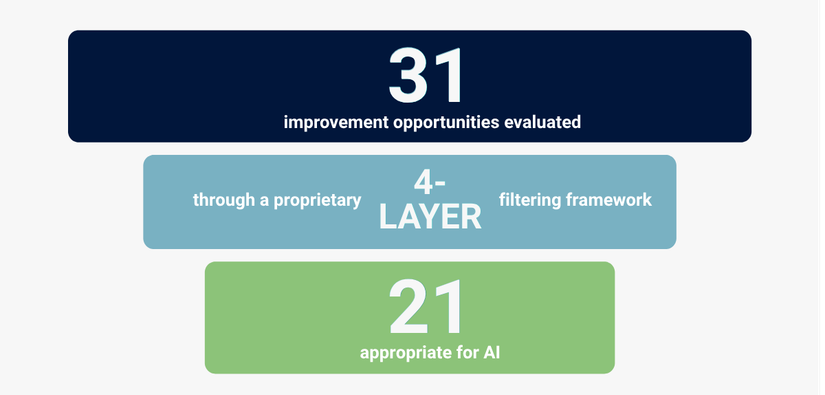
Discovery identified 31 improvement opportunities, and 21 of them were flagged for further AI consideration. That didn’t mean building 21 AI solutions.
Some opportunities needed simple process changes. Others needed better information flow, clearer responsibilities or better use of existing systems. Where AI could add value, we assessed how it should fit into the redesigned workflow.
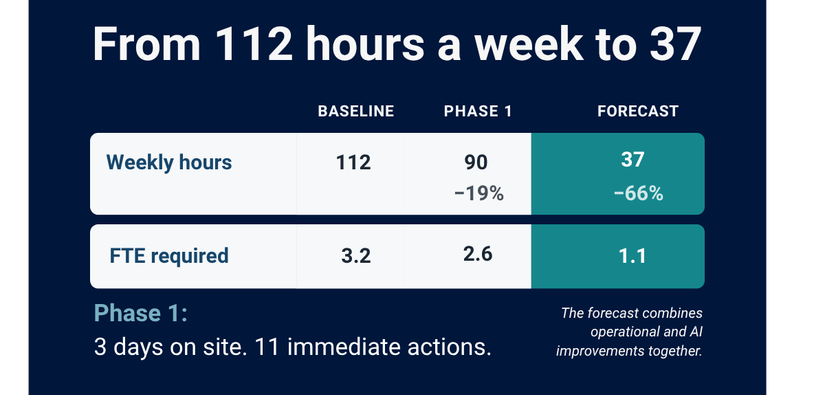
The resulting roadmap modelled weekly processing effort falling from about 112 hours to 90 hours through immediate improvements, and to 37 hours in the fully redesigned ideal state. That’s roughly 67% less weekly effort, from a combination of operational and AI-enabled changes.
What the exercise showed is that the opportunity wasn’t simply to introduce AI. It was to fundamentally improve how the complaints function operates, so it can absorb rising demand with more consistency and less avoidable effort.
From process efficiency to margin improvement
Margin conversations in life sciences usually focus on manufacturing efficiency, materials and supply chain. But there’s a significant, often overlooked opportunity in the transactional and administrative processes that keep a regulated business running. Operational excellence expertise tends to be concentrated on the production floor, so these back-office processes rarely get the same attention.
Manual data handling, duplicated activities, rework, waiting time and fragmented systems don’t just slow things down. They consume skilled capacity, and that cost grows with workload.
In our complaints example, the ideal-state model pointed to a reduction of about 75 hours of weekly effort. Framed the other way, that’s 75 hours of avoidable effort the business pays for every week the process stays as it is. The cost of inaction is real, even if it never appears as a line item.
Released capacity isn’t automatically a financial saving. The commercial benefit depends on how it’s used: reducing overtime, avoiding recruitment, absorbing growth or redeploying experts to higher-value work. But better process design creates options that didn’t exist before, and when those options translate into measurable operating cost, avoided spend and productive capacity, process improvement becomes a tangible contributor to margin.
Where AI can make a real difference
Once you understand the current process and have designed a better one, it’s much easier to see where technology fits. One recurring issue in our complaints example was the “swivel-chair” problem: people constantly moving between systems to retrieve information and transfer data.
That opens the door for automation and AI to help gather information from approved sources, extract details from incoming correspondence, prepare draft records and support internal communications.
There’s a quality benefit here too, not just an efficiency one. Every time someone switches systems, re-keys data or hunts for a document, they spend mental effort that has nothing to do with the decision in front of them. In a high-volume, high-pressure environment that cognitive load builds up, and it’s where transcription errors, missed details and inconsistent decisions creep in. Automating the repetitive, low-judgement steps reduces that load and the chance of error, so investigators can focus their attention on the assessments that need their expertise. Less avoidable effort isn’t just faster. It’s safer.
AI doesn’t replace qualified judgement or decide regulatory reportability. In regulated processes that distinction matters, and any solution has to be assessed against its intended use, risks, verification needs and the controls needed to stay compliant.

AI also has a role after the redesign. Improved processes tend to drift back towards old habits over time. Used well, AI can help monitor performance and flag that drift early, so the gains last longer.
And sometimes the best solution won’t involve AI at all. We should choose the technology to fit the problem, not look for problems to justify the technology.
People and culture are central to the solution
An organisation will never be just a collection of processes, systems and technologies. It is a collection of people, enabled by its processes, systems and technologies. Lose sight of that and even the best-designed process or most capable AI tool will struggle to deliver.
That’s why culture matters as much as the process design itself. Improvement lasts where people feel safe to raise problems, challenge how things are done and see improving the work as part of their job, not something done to them. Introduce new technology into a culture that isn’t ready for it, and people will work around it rather than with it.
Our discovery workshops are built with this in mind and are deliberately hands-on. We bring the relevant teams together, map the process on the walls and work through the challenges collaboratively. The people in the process every day identify the problems and shape the improvements. Our role is to facilitate, challenge assumptions, bring domain and external perspective, and turn their insight into a structured roadmap.
This pays off beyond the process design. People support changes they’ve helped build. They come away understanding their own workflow, the dependencies between functions and where technology can help. And because we transfer the methods as well as the findings, the team keeps the capability to keep improving after we’ve left.
When people map their own processes, identify their own pain points and develop their own solutions, they become the drivers of change rather than the recipients of it. Over time, that’s how a culture of continuous improvement takes hold.

Start with performance, then decide where AI fits
For Quality and Regulatory leaders considering AI, my recommendation is to start with a measurable operational problem: where workload is growing, what drives cycle time, where rework happens and which activities depend on manual effort. Understand the process as it actually runs, not just as the procedure describes it, and redesign it with the people who do the work.
Then decide which improvements come from Lean redesign, which from existing technology and where AI adds further value. Start with targeted opportunities that are practical, measurable and proportionate in risk, and build confidence before scaling. Measure success by process performance (rework, consistency, right-first-time, workload sustainability and decision quality), not by the number of AI tools deployed.
Technology alone won’t create a high-performing Quality or Regulatory function. Lasting improvement comes from an integrated approach: people-focused, enabled by Lean, optimised by AI and driven by domain expertise, so skilled professionals spend less time navigating fragmented systems and more on the work that needs their judgement.
Find the friction. Redesign the process. Apply technology where it adds value.
Measure the impact. That’s how we build Quality and Regulatory operations that are compliant, effective and commercially sustainable, protecting quality while creating capacity and contributing to margin improvement.
Our webinar series explores each of these themes through practical demonstrations, expert perspectives and real-world considerations for Quality, Regulatory, Clinical and R&D teams.